This Musicians’ Musings features Karen Hansen Gurstelle. Karen is one of 75 member musicians who play in the Bloomington Symphony Orchestra for the love of music. Each musician brings their time, talents, and treasures to the BSO, and every person has unique experiences and gifts that they offer to the orchestra. Over the course of the year, we’re telling their stories. We invite you to learn more about the musicians you see onstage at every BSO concert.
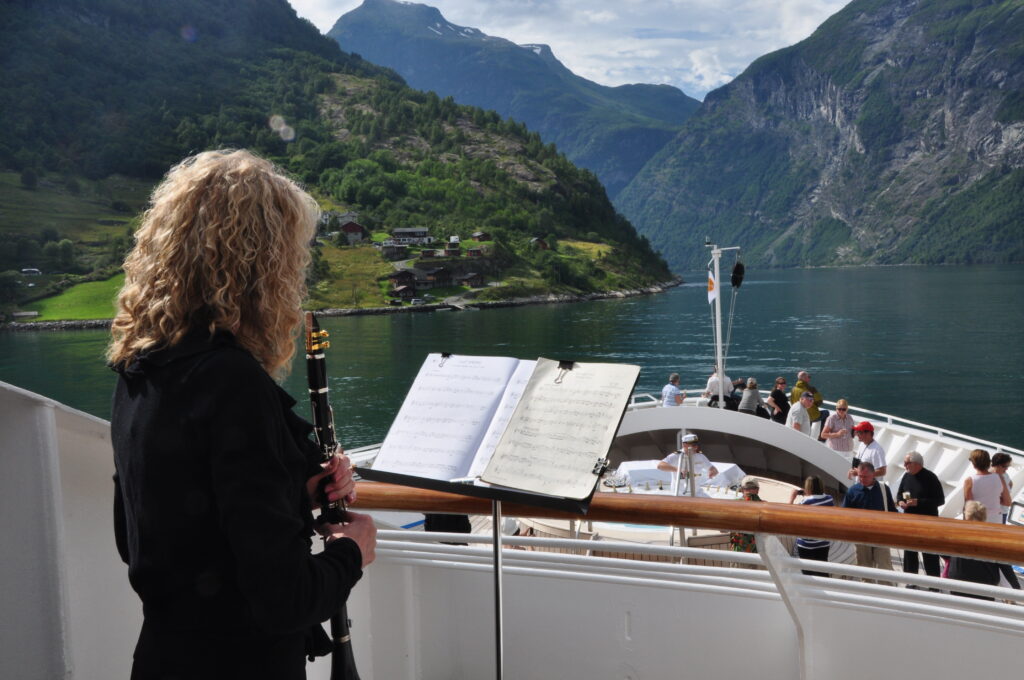
Grieg concert in the Geiranger Fjord, Norway
Tell us your name and what you play.
Karen Hansen Gurstelle, and I play clarinet in the BSO. I also play in the Rochester Symphony and Mississippi Valley Orchestra and three chamber ensembles: Dolce Winds with flutist Nancy Wucherpfennig, oboist Kaia Sand, and bassoonist Ford Campbell; The Incidental Trio with violist Steve Staruch and pianist Sue Ruby; and a new trio with cellist Nate Brunette and pianist Jonathan Seaberg. I enjoy a variety of freelance jobs that have ranged from the premieres of three operas to a recent album release concert with singer/songwriter/pianist Scottie Miller and his band.
What do you do in the rest of your life?
At Cadenza Music in St. Paul I teach clarinetists from middle school age through adults. I enjoy passing along what I’ve learned from performing and from seven great teachers at Minnesota Orchestra, Orono schools, St. Olaf College, and UW-Madison. Teaching music is still best offered from one human to another, when I can help a student with what they need most in that lesson with a piece, audition prep, technique, or equipment. That’s akin to live performance. Musicians have the great privilege of collectively bringing composers’ creations to life in the moment for in-person audiences.
What do you like to do outside of music?
Hang out at home, hike, and travel with my husband, William Gurstelle. I run with a group of marathoners who taught me how to compete in half marathons and 10-milers, and I read a lot.
Tell us about the Karen Hansen Gurstelle Fund for Creative Repertoire Expansion. Where did you get the idea and what are your goals for the fund?
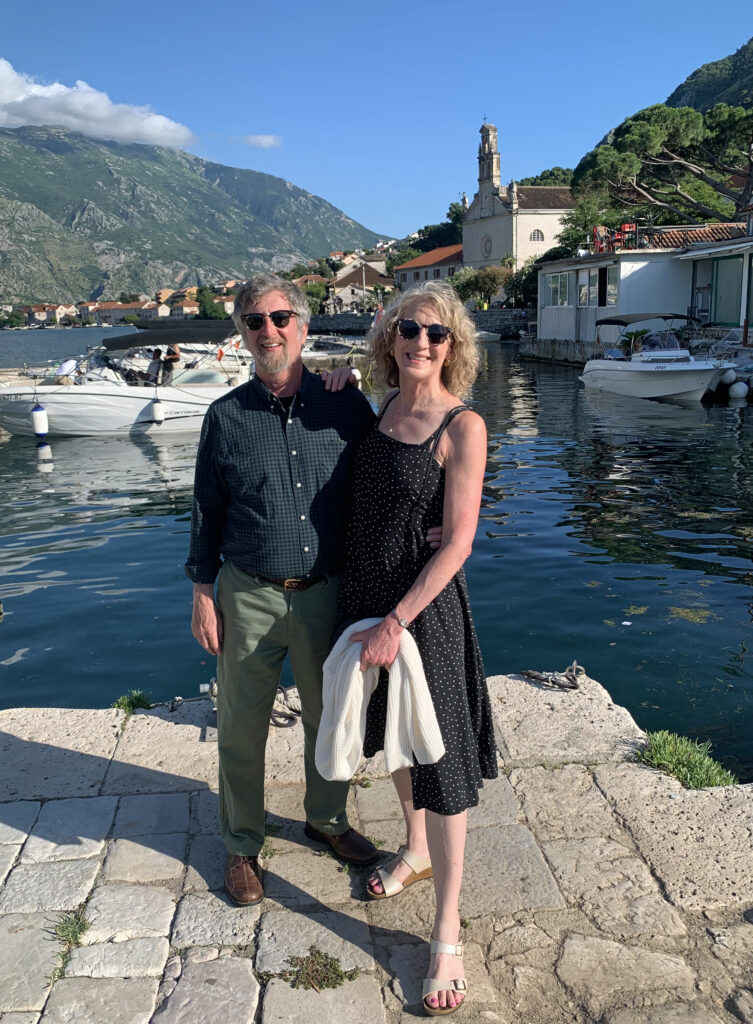
Bill and Karen before a guitar duo concert in Kotor, Montenegro
It’s been an evolving idea. I’ve always had an international bent—studying French, German, and Norwegian; working as an au pair near Paris and as a bilingual salesclerk in Berlin; and studying music, theater, and art in London and Scandinavia. For a couple years I wrote arts and culture articles for Viking, the international magazine of the Sons of Norway. Since 2008, I’ve been working two or three times a year on cruise ships as an arts and music enrichment lecturer, an ideal blend of international experience with teaching and performing. Bill lectures on science and history. It’s a great gig that takes us all over the world.
Curating culturally distinctive examples for my lectures has led me to composers I mostly hadn’t encountered in my performing career. I fell in love with many of their works and want to play them with my colleagues.
At a happy hour after a BSO dress rehearsal, Manny, Sara Tan, and I talked about programming more music from other cultures. Acquiring scores and parts for such works can be expensive, and sometimes there are added costs for extra instruments and players. When Manny programs relatively expensive works, he has to choose less expensive works for the rest of the season to stay within the programming budget. He mentioned a couple of Cuban composers whose works he’d like to perform, but for the expense. It made me sad that, for want of a bit of cash, Manny has to make trade-offs in his programming dreams.
Through the fund, I want to help expand the repertoire that the BSO performs by covering the extra costs of programming music by women composers; by composers of African, Asian, Caribbean, and Latin American origin or heritage; and by European composers whose works don’t get much play in the United States.
Why is elevating the repertoire of underrepresented composers important to you?
In preparing my arts lectures, I have auditioned thousands of tracks of classical, traditional, and popular music from all parts of Europe, plus Alaska, Australia, the Caribbean, Central and South America, Egypt, Japan, New Zealand, South Africa, and Russia.
There is so much beautiful music born of different individual and cultural origins, and I want the musical voices and souls of those cultures to reach more performers and listeners. It is glorious to perform beloved standard repertoire and have the buzz and challenge of preparing works that are new to us and then draw the audience in to enjoy them with us.
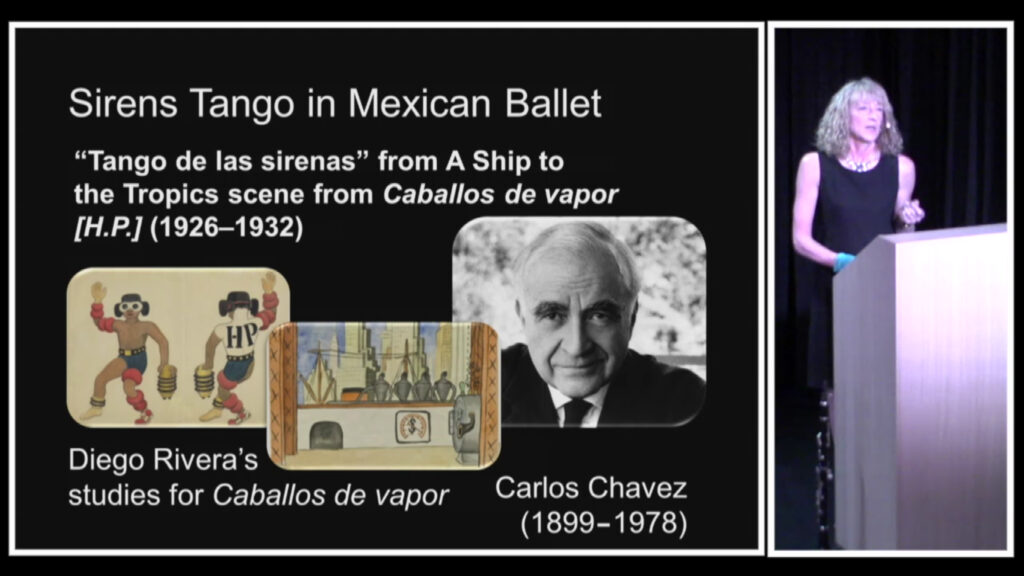
Karen giving her cruise ship lecture “Shanties and Sirens on the High Seas and on Stage”
After the dress rehearsal of Arturo Marquez’s Danzón No. 2, Manny told us that if we performed it like that, none of us would have trouble getting a date! It made me happy that the orchestra and audience seemed to enjoy the piece as much as I do. I had asked Manny to program it because, after years of coaching many Central High School clarinetists on the solos, I hadn’t gotten to perform them! Two of my students attended BSO’s performance, making a gratifying full circle. Now that Danzón No. 2 is widely performed, it would be fun to play Marquez’s Danzón No. 9 and Danzón No. 7.
Tell us about a composer you have discovered who doesn’t have the following he/she/they deserve?
Several I’ve featured in my arts lectures are becoming better known, including Eleanor Alberga, Joseph Bologne, Lili Boulanger, Anna Clyne, Samuel Coleridge-Taylor, Guido López-Gavilán, Arturo Márquez, Dora Pejačević, Rachel Portman, Fazıl Say, Roberto Sierra, Nikos Skalkottas, William Grant Still, and Judith Weir.
Two more I’d love to see emerge from the programming shadows are Pauline Hall (1890–1969) and Wilhelm Stenhammar (1871–1927).
Swedish composer Wilhelm Stenhammar’s Serenade in F major, Op. 31 (1908–13, rev. 1919) is a piece that, upon first hearing, makes you wonder, “How is this not yet a hit and part of the standard repertoire?” Stenhammar conceived the piece while in Florence in 1907. Royal Stockholm Philharmonic program notes call it “sensual southern European music presented in Nordic light – playful, lyrical and beautiful.” Stenhammar developed the Serenade in F while he was studying counterpoint rooted in Renaissance practice and seeking his own clear, joyful musical language beyond late Romanticism. With lyrical melodic lines and agile passagework for virtually every section, the serenade breathes and reflects, sings and dances.
In Norwegian composer Pauline Hall’s Verlaine Suite (1929), impressionist color meets Nordic clarity in her orchestral expression of poems by French writer Paul Verlaine (1844–1896). Who could fail to be drawn in by an opening movement titled “This is languorous ecstasy” and a finale depicting a dizzying carousel ride at a fair? Influenced by French and Russian composers, Hall was at the forefront of welcoming international influences into post-Grieg Norway. Her work was criticized in Norway for being too French-influenced. Oh là là! My French ancestors roll in their graves.
Where has music taken you in your life?
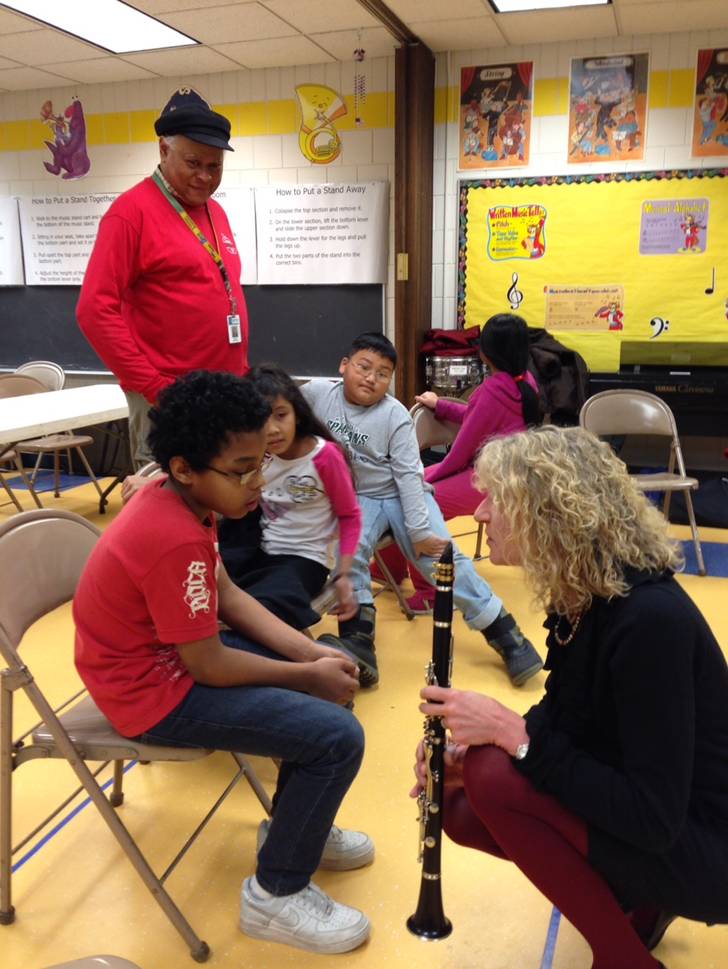
Masterclass at Saint Paul Music Academy after a MPR Class Notes concert by Dolce Wind Quintet
Playing in the backing orchestra with the Moody Blues was a trip, complete with marijuana smoke drifting in the upper reaches of the sold-out Mayo Civic Center in Rochester.
In a rock quarry in St. Cloud with 150 musicians and the Merce Cunningham Dance company, I played in OCEAN, which was named to the Los Angeles Times’ top ten ‘Best in Classical Music 2008.’ My perch was right above the stage entrance where Merce Cunningham (1919–2009) watched every performance from his wheelchair. A lover of ballet since I was a tiny tot, I dedicated my playing to that great American choreographer and modern dance visionary.
In 2014, at the request of the Norwegian captain of a small cruise ship, I played songs by Edvard Grieg as the ship sailed through the Geiranger Fjord in Norway. Waterfalls plummeted from cliffs on both sides while the passengers ate caviar and drank champagne on the deck below me.
What difference has music played in your life?
It is who I am and why I’m here.
The BSO’s October 11, 2026 performance of William Grant Still’s Symphony No. 1, “Afro-American” is presented by the Karen Hansen Gurstelle Fund for Creative Repertoire Expansion. If you would like to learn more about how you can give to a specific project or to the BSO in general, please contact Sara Tan, Executive Director.